
Structural Dependency in Pacific Labour Mobility
Sovereignty • Institutional Systems Architecture • National Resilience • Institutional Power
Diagnosing structural coercion in Australia's primary Pacific mobility instrument and re-engineering the architecture from placement system to sovereign labour infrastructure.
The Structural Condition
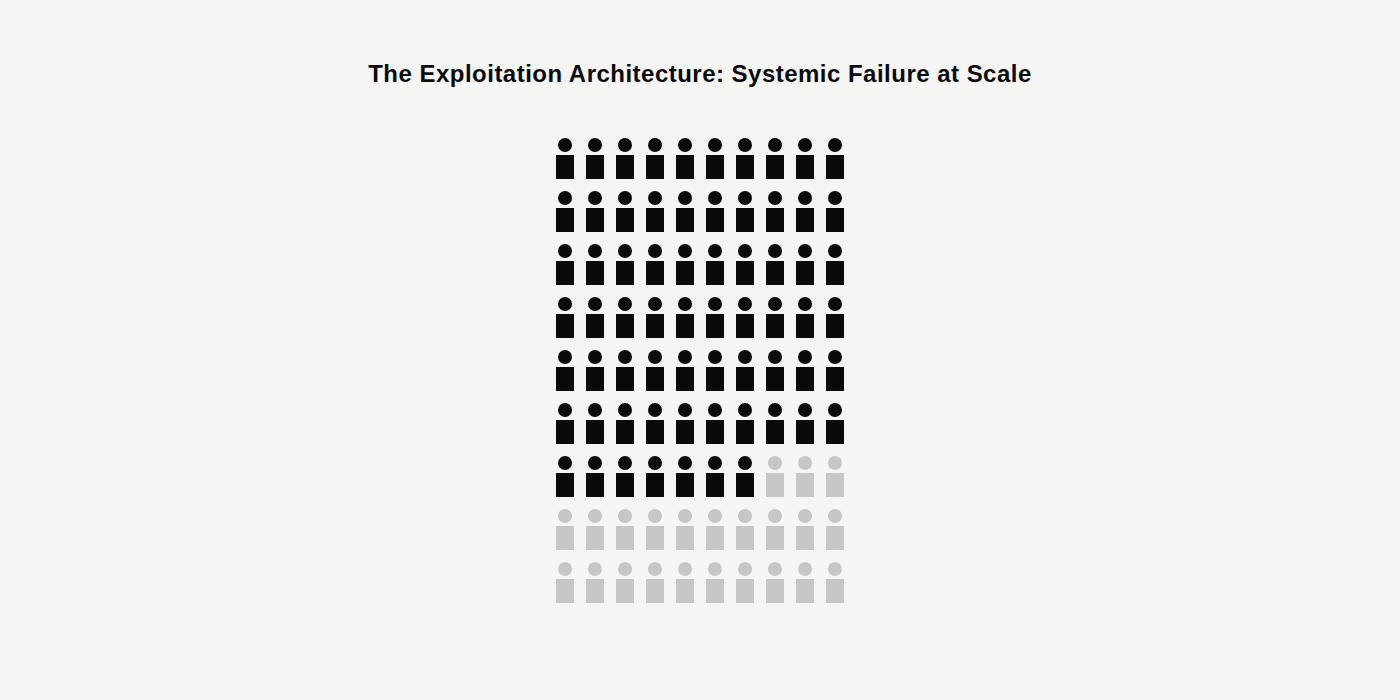
By 2023, the Pacific Australia Labour Mobility (PALM) program administered 30,000+ workers through regulatory architecture that remained unenforceable at the operational layer. A single-employer visa tie sat at the centre of this architecture, creating a structural dependency trap. Workers reporting abuse risked immediate deportation and the collapse of household remittance flows ($1,061–$1,310/month). By mid-2023, 7,000 workers had disengaged into the shadow economy, stripped of legal protections.
The liabilities were compounding across every layer. Worker disengagement threatened critical sectors supporting $20B+ in export infrastructure. Reports of modern slavery eroded Australia's standing as a credible partner in the Indo-Pacific. The $1B+ annual remittance flow that functions as the de facto resilience infrastructure of the Pacific was destabilising. Each liability reinforced the others.
THE ENGAGEMENT
Client: Department of Employment and Workplace Relations (DEWR)
Role: Principal Institutional Architect, Workforce and Economic Systems
Scope: Architectural redesign of the end-to-end PALM lifecycle, spanning systems integration, labour market testing, accommodation standards, welfare protocols, employer competency frameworks, incident management, and monitoring and assurance mechanisms.
THE DIAGNOSTIC
The Enforcement Gap
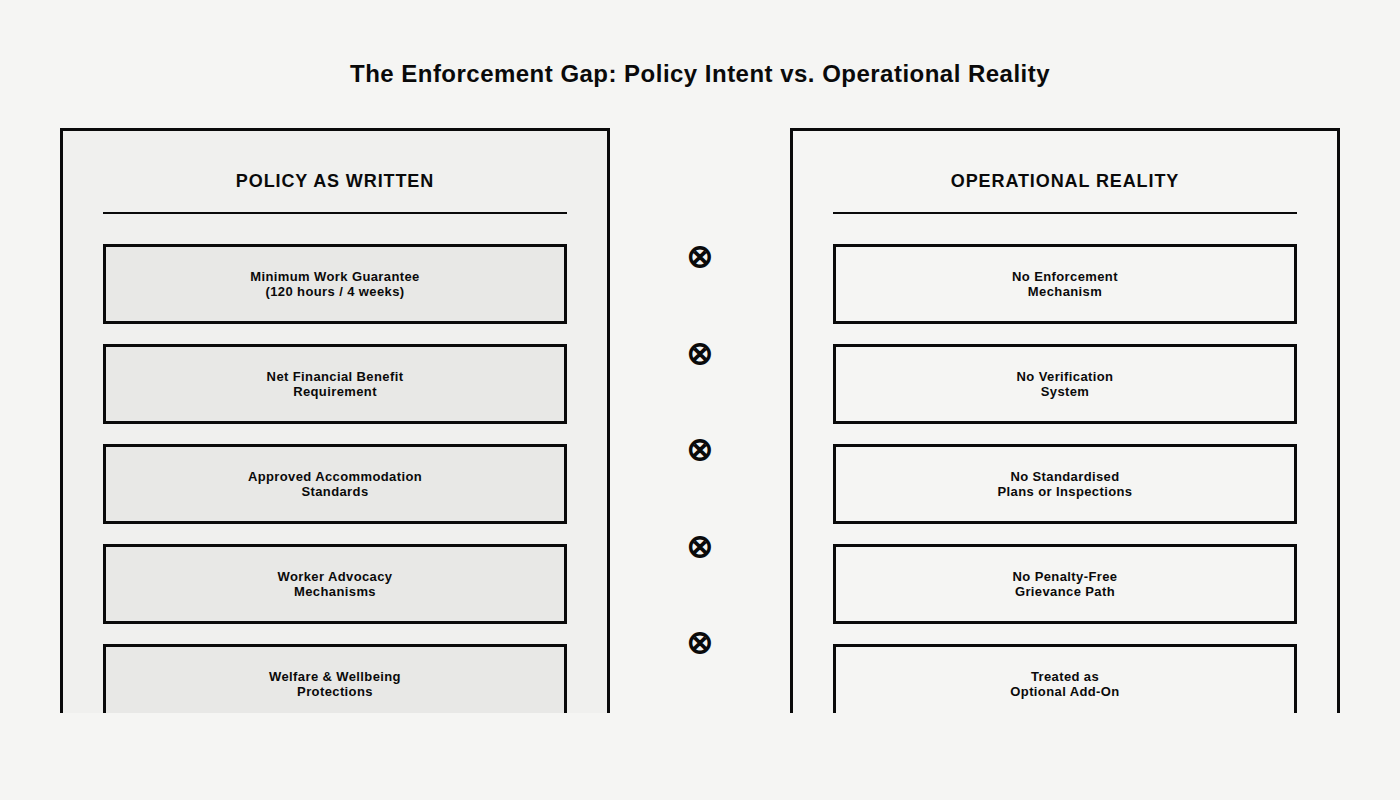
Regulatory protections existed in policy. PALMIS, the system responsible for operationalising them, functioned as a placement database with no compliance capability. Employers charged $120–$160/week for substandard accommodation with no standardised verification. Workers had no accessible grievance pathway that could be used without triggering visa cancellation. The regulatory framework was architectured around the employer relationship. Worker protection had no structural presence in the system.
The Accommodation Profiteering Vector
Approved accommodation plans were disconnected from actual welfare outcomes. Deductions were automatically extracted from wages with no transparency into whether charges reflected costs or profit extraction. The absence of standardised frameworks meant no baseline against which to measure compliance, creating the single largest exploitation vector in the program.
The Cultural Competency Void
Employers managing 500+ PALM workers across multiple sites lacked structured frameworks for cross-cultural communication, conflict resolution, or understanding of Pacific kinship obligations. Preventable friction escalated into grievances, disengagement, and worker departure into the informal economy.
The Incident Management Black Box
When exploitation occurred, there was no structured response protocol. Workers faced ad-hoc employer responses with no external oversight. DEWR lacked real-time visibility until disputes escalated to formal complaints or worker disappearance. The system operated in permanent reactive crisis mode, absorbing each incident individually with no structural capacity to prevent the next. Anticipatory Governance had never been built into the program architecture.
The Architecture Failure
The program carried regulatory intent in its legislation. The operational translation mechanisms required to make that intent enforceable — the data structures, the standardised frameworks, the monitoring systems, the advocacy pathways, had never been built. Australia's geopolitical positioning in the Pacific depends on PALM functioning as proof of ethical labour mobility. When the architecture permits exploitation, it validates critiques from competing powers that Australia extracts value without reciprocal dignity. The program becomes a strategic liability that compounds with each reported incident of worker harm.
The Architectural Intervention
The program was re-architected across the full lifecycle. Policy that had existed as aspiration was converted into operational requirement with enforceable verification at every stage.
Recommended Architecture
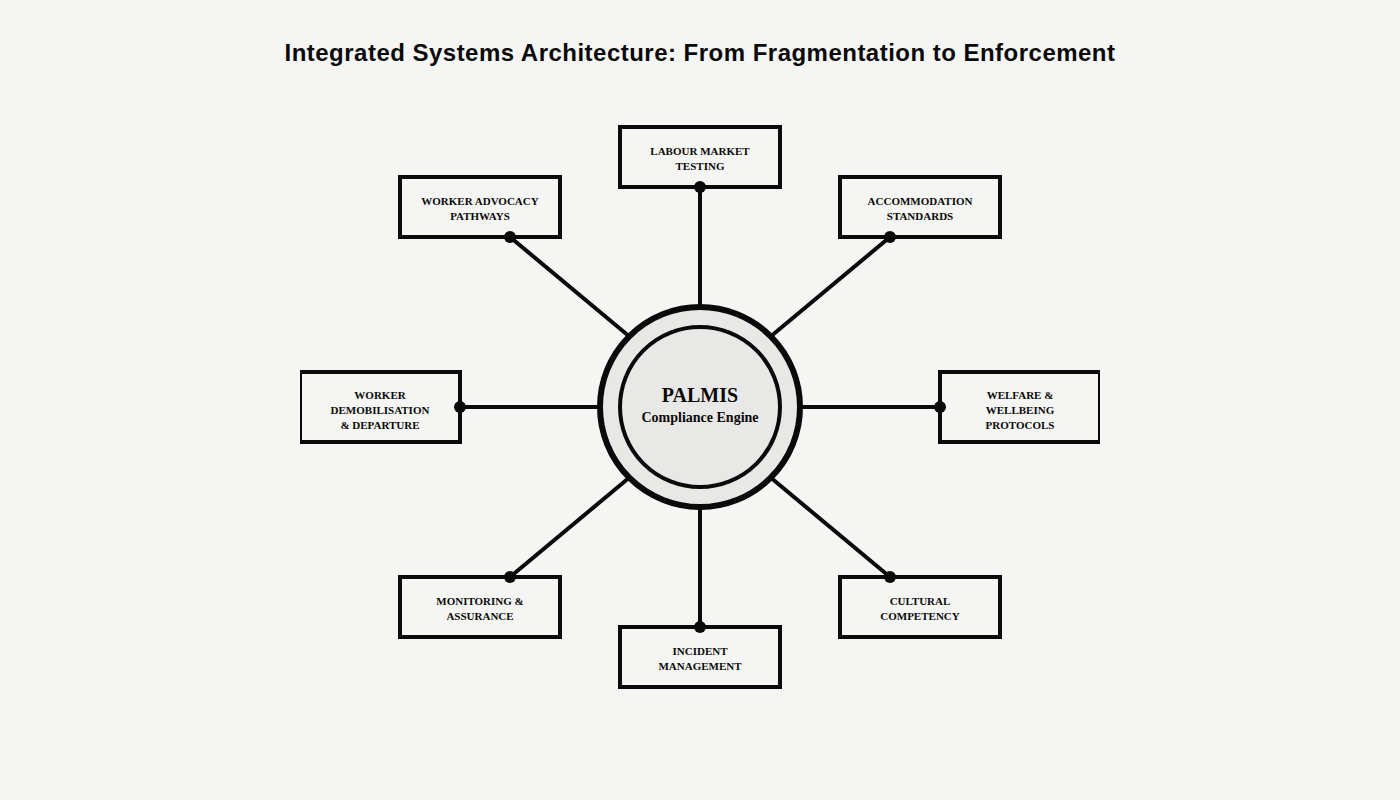
Compliance Enforcement Engine: PALMIS rebuilt as a verification system. Employers must now submit digitally verifiable evidence of work hours and welfare checks to maintain approved employer status. The system enforces compliance structurally rather than relying on self-reporting.
Standardised Accommodation: Welfare-first housing standards established with mandatory cost transparency and independent inspection protocols. The accommodation profiteering vector identified in the diagnostic is closed at the architectural level.
Proactive Monitoring: Scheduled compliance verification through data pattern analysis and site inspections embedded as a standing function. The monitoring architecture operates continuously rather than waiting for complaints to trigger oversight.
Cultural Competency Standards: Mandatory training frameworks for employers, making cross-cultural competency a condition of approved employer status. The friction that produced grievances, disengagement, and departure into the informal economy is prevented at the point of entry to the program.
OUTCOMES
The re-architected PALM program now functions as operational proof of sovereignty through systems design. Worker disengagement declining across high-volume agricultural sites. Labour supply chains supporting $20B+ in export infrastructure stabilised. Australia's commitment to ethical mobility now demonstrable in Pacific forums, strengthening negotiating leverage in the region. Infrastructure established to absorb future climate-driven mobility pressures through Pacific Engagement Visa pathways.
Required Next Steps
The architecture must be matured into a permanent instrument of statecraft to prevent administrative drift from reopening the conditions the diagnostic identified.
Eliminate Visa Bonding: Transition to sector-based mobility models to remove the structural dependency trap at its source.
Social Protection Extension: Immediate Medicare and superannuation access, positioning workers as essential contributors to national security infrastructure.
Skills Transfer: Certification pathways so workers return to Pacific nations with qualifications in healthcare and logistics, deepening regional institutional ties and converting labour mobility into sovereign capability development.