
THe Framework
The gap between what an institution's strategy assumes and what underlying conditions can actually support opens gradually, compounds invisibly, and is almost never diagnosed until the window for correction has already closed. This condition is Structural Drift. Twelve failure mechanisms produce it. Three clusters organise them. Each one is diagnosable before it produces the crisis that finally forces attention to the layer where the problem was always operating.
The Structure
Every institution is built in three layers. Stability depends entirely on whether they remain aligned.
THE SUBSTRATUM
The physical foundation. Energy systems, demographics, resource flows, geography, biology. This layer sets the maximum load any system can bear. You cannot legislate your way out of insufficient kilowatts. You cannot debate your way out of a collapsing dependency ratio. The Substratum does not negotiate.
THE SUPERSTRUCTURE
The institutional framework built on the Substratum. Governance, law, infrastructure, fiscal architecture, foreign policy. These are the load-bearing walls. When they stop aligning with the Substratum, the structure begins to settle unevenly. Systems that were stable for decades fail under loads they were once designed to carry. This misalignment is Structural Drift in motion.
THE SURFACE
Markets, discourse, technology adoption, political theatre. This layer is loud, visible, and economically dynamic. It is also the least consequential to whether the structure stands or collapses. The Surface can distract indefinitely. It cannot hold weight.
An entire class of institutions now exists whose primary function is to interpret the Surface. They argue about the cladding while the foundation is in shear.
Twelve Pathologies. Three Clusters
Structural Drift announces itself through recognisable patterns. Recurring, diagnosable, and in most cases already operating inside institutions that have not yet developed language for what is happening to them.
1. Physical Ceiling
Where strategy hits the hard limit of material reality.
Mathematical Failure: The numbers the institution was built on have stopped adding up. Demographic ratios, fiscal formulae, growth assumptions. The ground has shifted. The architecture still runs on the original arithmetic.
Physical Bottleneck: Capital and policy commitments are moving faster than the physical infrastructure required to deliver them can be built. The gap between what has been announced and what can physically be delivered is structural.
Cascade Coupling: Components across the operating architecture are so interdependent that a single failure anywhere in the network propagates through the couplings before any institution can detect what is happening, let alone respond. The trigger is local. The consequence is systemic.
2. Structural Drag
The accumulated weight that prevents forward motion.
Optimisation Trap: Decades of efficiency-driven reform have systematically removed every buffer, redundancy, and slack from the operating architecture. The tolerance that would allow the institution to absorb pressure, adapt, or respond to the unexpected no longer exists.
VestigialArchitecture: Governance structures, committees, and reporting frameworks still actively operate and consume resources for conditions that no longer exist. They persist because removing them is costly, politically contested, and procedurally complex.
Paradigm Drag: New structures built to address emerging conditions still carry the assumptions, questions, and problem definitions of the era being replaced. The structures are current. The thinking embedded in them is inherited.
Framework Impedance: Rules, regulations, and compliance architectures have accumulated to the point where they actively block reforms the institution has committed to delivering. The institution is constrained by the very framework it operates within.
Regulatory Capture: Oversight functions designed to hold an institution accountable have gradually reoriented toward the interests of the parties they regulate.
Sovereignty Leak: Operational capability and institutional know-how have been progressively transferred to external parties through successive rounds of outsourcing and restructuring. The institution can no longer execute its own mandate without dependence on actors whose interests diverge from its own.
3. Signal Distortion
Where the institution loses contact with its own condition.
Diagnostic Failure: The reporting architecture has decoupled from the structural conditions that determine whether the institution remains viable. The early warning systems, feedback loops, and sensing mechanisms that should detect the divergence have been defunded, ignored, or optimised away.
Semantic Drift: Institutional language progressively adopts the vocabulary of reform, accountability, and contemporary governance. The underlying practices and incentive structures remain unrevised. The language describes compliance with a standard the institution has not operationally met.
Temporal Dislocation: Decision cycles are structurally misaligned with the timescales at which the conditions they govern actually change. Some conditions move faster than any cycle can track. Others require commitment horizons longer than any cycle permits.
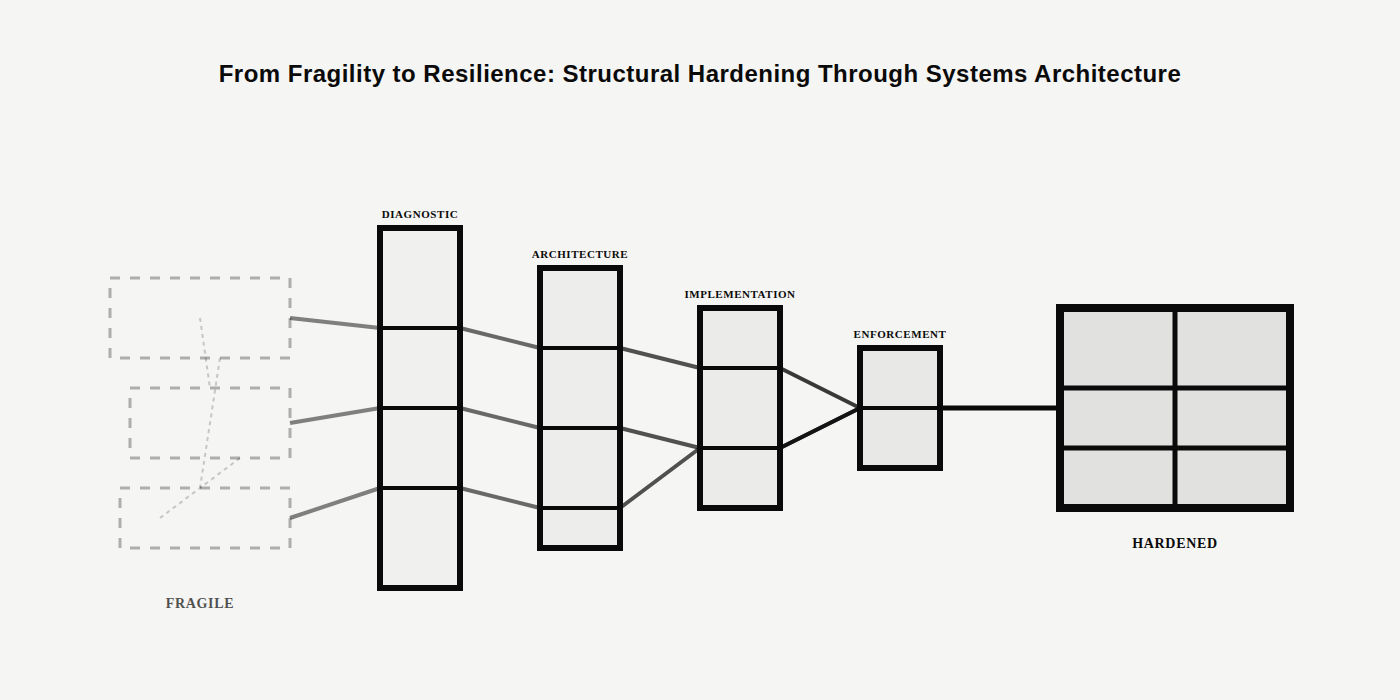
From Diagnosis to Redesign
Naming the structural fault is the first half of the work. Redesigning the architecture is the second. Five principles govern how.
1. Diagnose at the structural level. The presenting problem is almost never the real problem. The real problem is in the architecture: the coupling, the dependencies, the load-bearing assumptions the system was built on.
2. The architecture is designed, therefore it can be redesigned. Every structural pathology is the result of design decisions that no longer fit present conditions, and every pathology is maintained by the interests it serves.
3. Redesign the relationships between components. System behaviour is determined by coupling, dependencies, and interfaces. Replacing components without redesigning these relationships reproduces the same failure.
4. Work within the live system. The existing architecture does not pause for redesign. What moves first, what gets retired, and what gets built is determined by the structural dependencies of the system.
5. Design the architecture to evolve. The redesigned institution must be able to detect its own drift and initiate its own transitions. That capacity is a structural requirement, not an afterthought.
The Framework Reference
A downloadable diagnostic reference. The three-layer model, twelve pathologies, and the structural conditions each one identifies. Designed to be carried into the room where the decision is made.