
THE CARE-LED ECONOMY
National Resilience • Institutional Systems Architecture • Anticipatory Governance • Sovereignty
The care economy as sovereign infrastructure.
Diagnosing the structural collapse of Australia's early childhood education sector and the architectural intervention required to rebuild it as economic foundation.
The Structural Condition
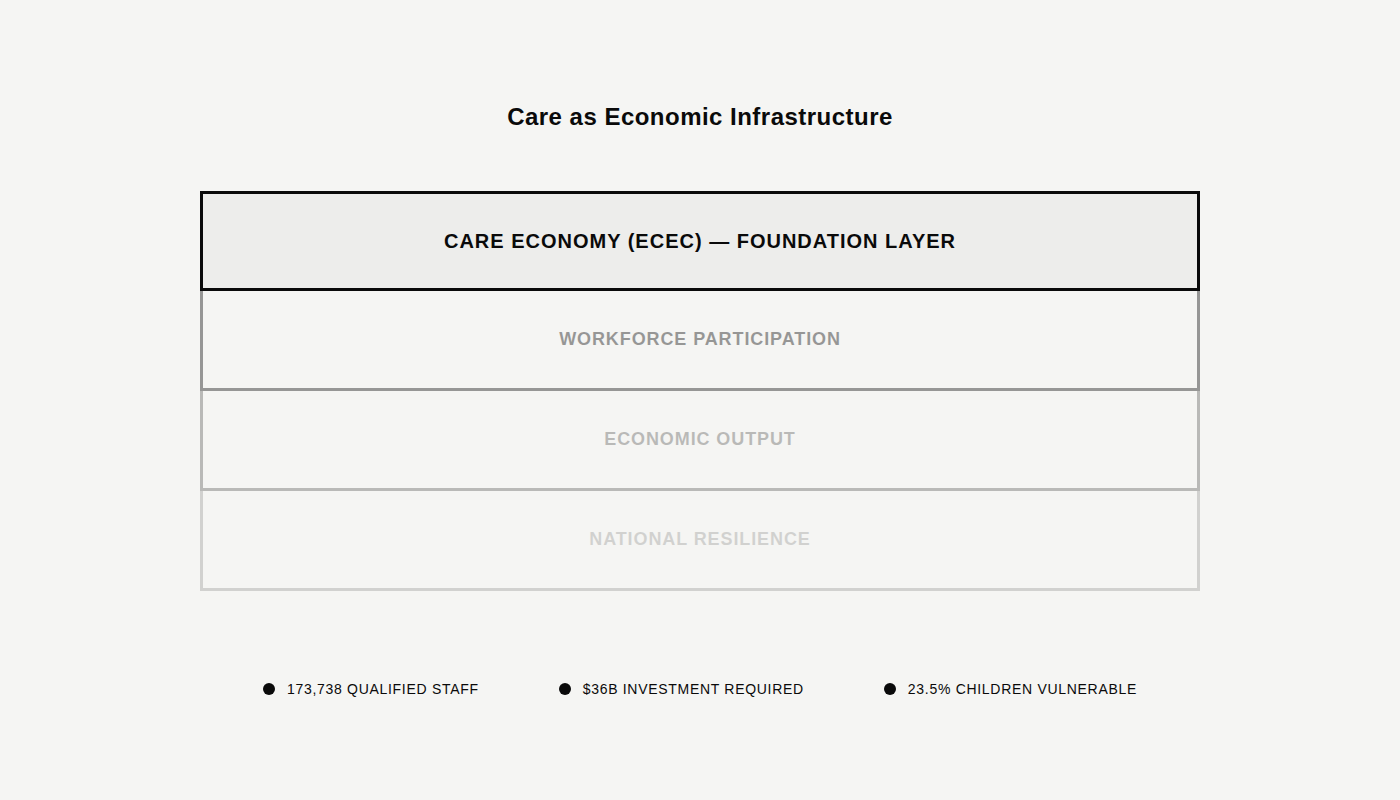
By 2022, Australia's Early Childhood Education & Care (ECEC) sector was in structural collapse. Decades of market-led policy design had treated care as a consumer discretionary good rather than essential economic infrastructure. The collapse was measurable:
Qualified educators leaving the sector despite increasing credential requirements.
Regional and remote communities unable to attract staff to meet mandatory educator-to-child ratios
Over 22% of children starting school developmentally vulnerable.
Billions of dollars in subsidy investment flowing through a fragmented system with no coherent outcomes framework.
The 2020 pandemic exposed what the architecture had already produced. It was the stress test, and the structures optimised for political optics rather than national resilience failed it.
THE ENGAGEMENT
Client: NSW Department of Education
Role: Principal Systems Designer, Care Economy Architecture
Scope: Structural diagnosis of federal and state funding mechanisms, workforce collapse drivers, COVID-19 subsidy consequences, and the architectural interventions required to rebuild the sector as sovereign infrastructure.
The brief was forensic: determine why billions of dollars in subsidy investment had failed to prevent workforce collapse and identify the intervention points required to stabilise the system from the Substratum up.
THE DIAGNOSTIC
The Reactionary Policy Cycle
Anticipatory Governance was structurally absent. The 2020 "Free Childcare" program replaced usage-based subsidies with a flat grant, creating a winners-and-losers architecture. High-quality centres were forced to cut hours, while low-capacity services with minimal overheads remained viable. The policy signalled to the workforce that their profession was expendable.
The Qualification Trap
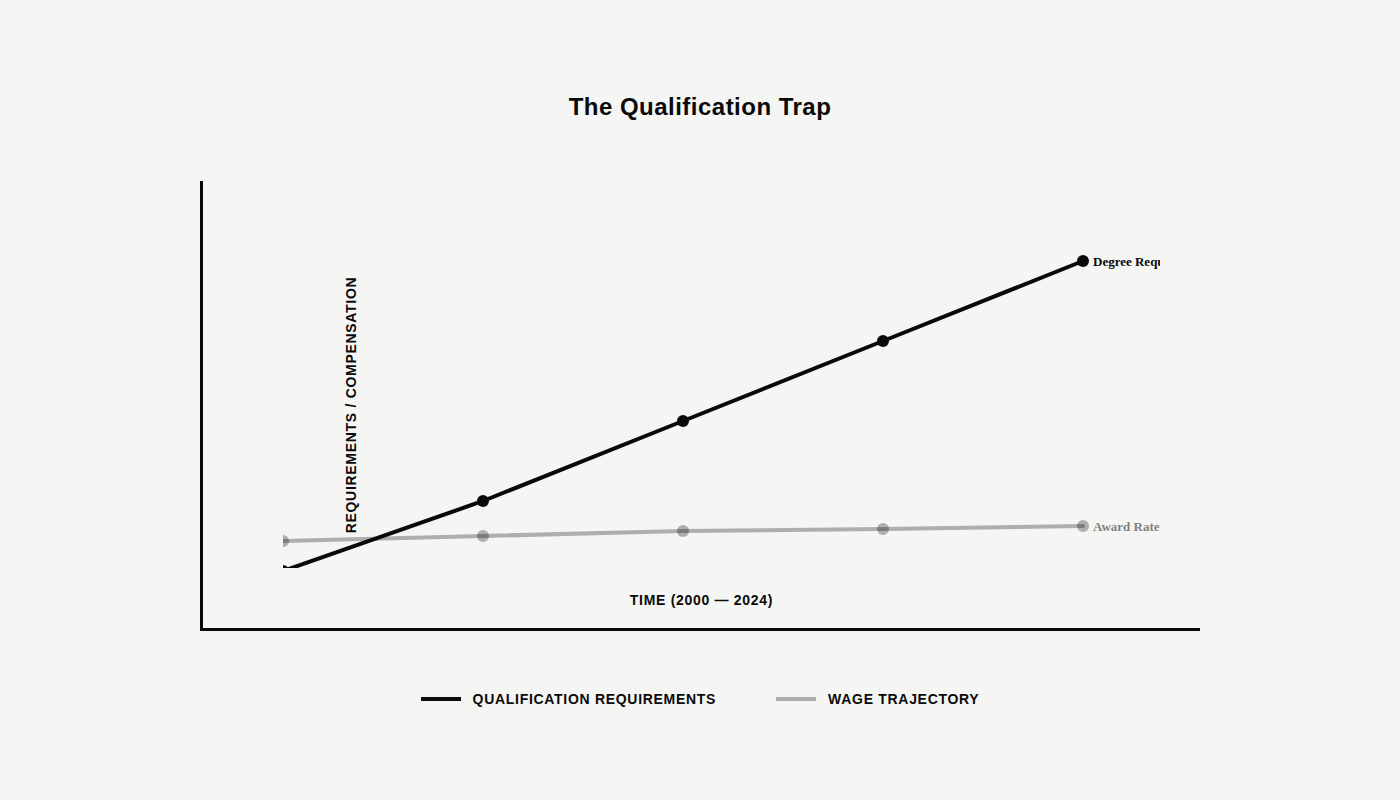
The sector operates under a Path Dependency that ensures its own failure. Regulatory requirements demand increasing qualifications. Wage settings remain anchored to an era when care work was classified as low-skill domestic labour and remunerated accordingly. The gap between what the system demands of its workforce and what it pays them has widened with every credential uplift.
The Sufficiency Gap
Post-pandemic Australia faces a sufficiency gap. The physical infrastructure is in place. The workforce to operate it has been structurally depleted. The system cannot absorb shocks, scale quality, or retain talent. The fragility is structural and compounding. In regional NSW, the downstream damage is already measurable: over 20% of children starting school developmentally vulnerable.
THE ARCHITECTURAL INTERVENTION
The root cause is the application of market-led logic to a domain that functions as sovereign infrastructure. Care is economic infrastructure. The funding architecture should reflect that. International evidence shows that public investment in care has a higher employment multiplier than construction or defence. The architecture required to correct this is a structural redesign of how care is funded, staffed, governed, and valued.
Recommended Approach
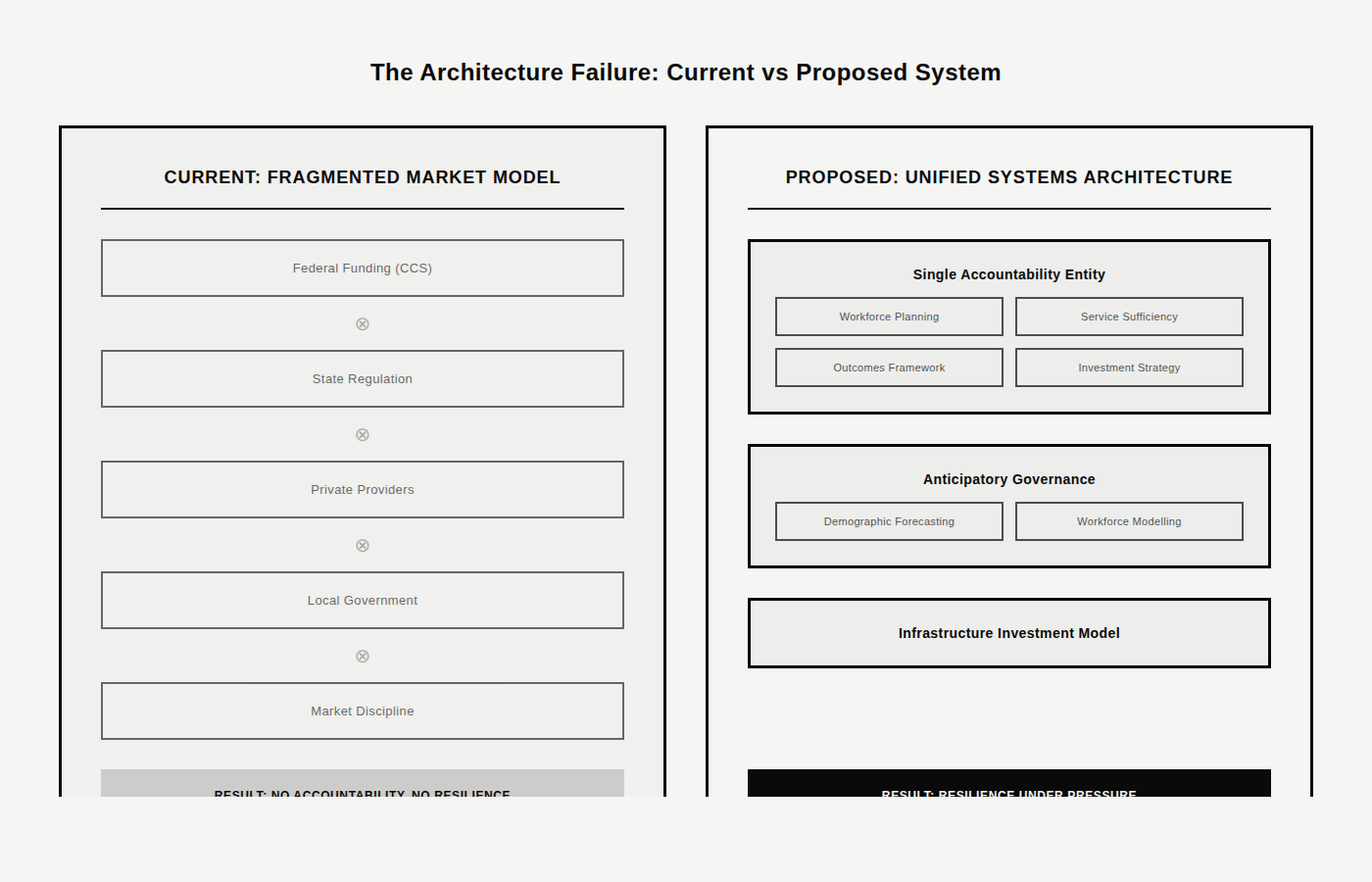
Unified Accountability Framework: A single entity responsible for workforce planning and developmental outcomes across the federal-state divide. The current fragmentation between federal funding and state delivery guarantees misalignment. The accountability architecture must match the scale of the problem.
Wage Architecture Reform: Remuneration remains anchored to an era when care work was classified as low-skill domestic labour. Credential and responsibility demands have escalated across every regulatory cycle since. Wages must be aligned to what the system now requires of its workforce. Without this alignment, the workforce pipeline remains structurally inverted.
Anticipatory Governance Cycles: Demographic forecasting embedded into policy design to eliminate reactionary subsidy shocks. The sector's history is a sequence of crisis responses to conditions that were visible a decade in advance. The forecasting capability exists in isolation, with no decision architecture connecting it to policy action within the current cycle.
Sovereign Capability: The required $36 billion investment positioned as sovereign economic infrastructure, securing workforce participation and long-term national stability. This is the Substratum investment that determines whether the care economy functions as an economic foundation or continues cycling through workforce collapse, reactionary subsidy intervention, and compounding developmental damage.
OUTCOMES
The structural interventions identified in this 2022 engagement remain the clearest available blueprint for sector recovery. Implementation remains a matter of political will. The sector's trajectory since 2022 has moved in the direction the diagnostic predicted.
The architecture for a resilient, care-led economy exists. The question is whether the state will fund care as sovereign infrastructure.